While strolling through the city centre, we suddenly come across Sloppy Joe’s. The bar is still there! It’s the place where James Wormold, Our Man in Havana, orders his morning daiquiri one day in January 1958. Graham Greene sets his novel on the eve of the fall of dictator Fulgencio Batista. You know what Cuba is like at that time from Hollywood films and tv shows: casinos, the mafia and tourists in Havana and on the coast; US companies exploiting the fruit and the sugar cane plantations; the majority of the Cubans, poor and illiterate, busy trying to survive. In the background, high up in the mountains, the armed resistance led by Fidel Castro and Ernesto ‘Che’ Guevara is growing. It is no longer possible to hide from the population and the tourists that the army and police regularly arrest, torture and murder protesters and suspected rebels or guerrilla fighters. “No Havana resident ever went to Sloppy Joe’s because it was the rendezvous of tourists; but tourists were sadly reduced nowadays in number, for the President’s regime was creaking dangerously towards its end” writes Greene.
It’s four o’clock now, time for our afternoon daiquiri. Inside, still no Habaneros. No tourists either. In fact, there is no one there except a friendly French-speaking waiter and two women behind the bar. There are also no daiquiris, mojitos, margaritas, cubanitos or cuba libres. That’s because there are no limes or lemons. This is, April and May last year, our first trip to Cuba, and we soon notice that a lot of everyday stuff is not available in Havana, and that when something breaks down, it is not repaired. Actually, Maria and I mainly wanted to see what a country is like, when it has been besieged by the United States for more than sixty years. As visitors – well, tourists – we wanted to try a small gesture of solidarity and possibly alleviate the hardship just a tiny bit (we were advised in advance by various parties to bring medicines for the population, but also items such as soap, sanitary towels, plasters and toilet paper – there is a shortage of everything, but especially personal care products).
At first glance, the city centres, tourist attractions and nature parks in or near provincial cities such as Cienfuegos, Santiago and Matanzas appear well maintained. “Apparently there is money for that, but not for the concrete needs of the local population”, says Maria. However, I would argue that it is precisely these attractions that draw tourists to the area, and it is these tourists who bring in foreign currency. Nevertheless, the buildings and institutions featured in the Oficinas de Información Turistica guidebooks have flaws and shortcomings that are difficult to hide. Many beautiful buildings have an air of decay about them. And at the most unexpected moments, both in Havana and in the countryside, the electricity goes out – for a short or longer period of time. No light, no cooling, no running water. The once-famous medical system, free and of high quality, is collapsing. Hospitals lack the basic resources to carry out their work – in the streets of Havana or Cienfuegos people are asking for medicine and other paramedical supplies. And as for petrol, our bus driver sometimes has to make enormous detours, since rationing only allows him to refuel in certain provinces.
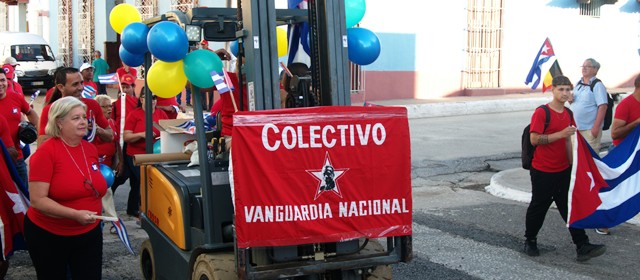
As we travel through the country, we notice a kind of ambivalence among the population. On 1 May, Maria, Stephan and I are already in the centre of Trinidad at 7 a.m. to watch the preparations for the Primero de Mayo parade. It is a huge public celebration. From early morning until after noon, thousands of people parade through the streets of the city, dressed up, singing and dancing on floats with huge sound systems. This is not a militant demonstration, but a feast, and all the businesses and hotels in the area send representatives with drums and trumpets. Most of the people we talk to still honour Fidel and Che as heroes, but then again, they may also express feelings of shame or frustration about the current situation. In Havana, for instance, our bus driver is ashamed about the stench of the enormous piles of rubbish on the streets, which are not being collected – while at the same time everyone knows full well that this is because there is no petrol for the refuse collection lorries. Younger people are frustrated that they are not allowed to leave the country and visit other places on earth, as the tourists they guide do. And how can we, as we are accustomed to doing, with our fancy euros buy local foodstuffs as souvenirs or gifts for those back home when the local population, with food vouchers in hand, have to queue to acquire scarce, affordable food?
On 8 January 1959, the Cuban rebels took Havana. Quite soon, the new government initiated the process of nationalisation of key economic sectors and expropriation of US American enterprises. Washington’s response included measures of retribution, such as the reduction of sugar imports from the island. On 6 April 1960, US Assistant Secretary of State Mallory wrote a memorandum regarding the economic blockade against Cuba. Its first sentence read: “The majority of Cubans support Fidel Castro.” But then it continues: “The only foreseeable means of alienating internal support is through disenchantment and disaffection based on economic dissatisfaction and hardship. If the above (…), it follows that every possible means should be undertaken promptly to weaken the economic life of Cuba. If such a policy is adopted, it should be the result of a positive decision which would call forth a line of action which, while as adroit and inconspicuous as possible, makes the greatest inroads in denying money and supplies to Cuba, to decrease monetary and real wages, to bring about hunger, desperation and overthrow of government.
The principal item in our economic quiver would be flexible authority in the sugar legislation. This needs to be sought urgently. All other avenues should likewise be explored. But first, a decision is necessary as to the line of our conduct. Would you wish to have such a proposal prepared for the Secretary?”
So, when in 1961 Castro proclaims the ‘socialist’ dimension of the revolution, US President John F. Kennedy imposes a comprehensive embargo on Cuba, encompassing the economic, commercial, and financial sectors. (US interference in Cuban affairs was nothing new, by the way. Theodore Roosevelt, the 26th president from 1901 to 1909, saw Latin America as a backyard in which the United States could intervene at will. Around 1900, he personally led a raid on Cuba with a cavalry regiment that was dubbed the ‘Roosevelt Rough Riders’ by the media.)
The sanctions imposed by the US affect more than just Cuba’s population. They also prevent other countries from doing business with the targeted country. The United States is indeed effectively assuming the right to punish not only states deemed to be pariahs (Iraq yesterday, Cuba, Iran or Russia today, for example), but also anyone who might trade with them. For example, in May 2014, BNP Paribas agreed to pay a fine of $8.97 billion for circumventing US embargoes imposed on Cuba, Iran, and Sudan between 2004 and 2012. In 1974, Bangladesh was rocked by the aftermath of the war with Pakistan and by massive floods that destroyed much of the countryside and caused a nationwide famine. Under President Nixon, the US made food aid dependent on the cessation of jute exports to Cuba.
This year, on 29 January, Donald Trump issued the executive order ‘Addressing threats to the United States by the government of Cuba’. “I find that the policies, practices, and actions of the Government of Cuba constitute an unusual and extraordinary threat, which has its source in whole or substantial part outside the United States, to the national security and foreign policy of the United States (…) and hereby declare a national emergency with respect to that threat.”
The designation of an ‘unusual and extraordinary threat’ and a ‘national emergency’ has a huge impact on Cuba’s development. It restricts access to international financing, technology and scientific cooperation. It hinders the financing of a genuine energy transition — for example, solar energy could be used on a much larger scale — and it deters foreign companies and non-governmental organisations from operating in Cuba for fear of legal complications. Through this executive order, Trump has turned the US tariff system into a weapon against any country, including Mexico, that dares to sell oil to Cuba. The aim is no longer to isolate or contain the Cuban people from the rest of the hemisphere, but to suffocate the country’s economy completely. The electricity grid, water pumps, public transport, hospitals, and schools all rely on imported fuel. By pressuring third countries, the US not just aims to impose sanctions, but to totally disrupt the functioning of the nation, to bring the country to its knees by suffocating it, ruining it economically and financially, and destabilising it.
Economic sanctions and blockade may not look like real war – tanks, artillery, drones and bombing – but in fact they are a form of warfare. Research of the University of Denver calculated the impact worldwide of economic sanctions imposed by the United States and Western Europe. The study, published in The Lancet, covers the period from 1971 to 2021. It shows: the weakest are the most affected. During that period, a total of 38 million people died as a result of economic sanctions, twice as many as during the First World War. In 2021 alone, 800,000 people died. That is more than all the deaths that occurred in military wars that year. The United Nations has since concluded that the victims of economic sanctions against countries in the Global South are mainly children and young people, the poorest segments of the population, young women and pregnant women, the elderly, and people with physical or mental disabilities.
And now, with Trump in power, economic warfare against Cuba is intensifying. After the kidnapping of Venezuelan president Maduro, he said “It’s going down for the count”, dismissing the need for military action, because the government would be likely to collapse on its own. On its own? Well, starvation is being used against the Cubans as a weapon to force them to give up their independence and/or to change their political system. The Cuban economy has been in crisis for years. On 18 September 2025, Bruno Rodríguez, Cuba’s Minister of Foreign Affairs, presented the government’s annual report on the impact of US sanctions. The losses for Cuba between March 2024 and February 2025 are estimated at 7.5 billion dollars. Poverty is rising rapidly due to ever-increasing food prices. The country has up till now not been able to recover from the enormous damage to the tourism industry caused by the Covid pandemic. (How sensible is it then, I ask myself, to state that restructuring tourism is a priority and to confirm that the sector is the engine of the national economy, as Prime Minister Marrero Cruz declared at the opening of the 43rd Feria Internacional de Turismo? Would you, as a nation, want to be dependent on tourists?)
So that’s how a boycott works out, at least for the population. I realise that, since its inception in 2005, I have supported the BDS movement against Israel. Boycott, Divestment, Sanctions. But is this what I would want for the Israeli population, what the Cubans are having to go through nowadays?
More about BDS soon, in On boycotting a state 2
En savoir plus sur rivieren & meren - rivières & lacs - rivers & lakes
Abonnez-vous pour recevoir les derniers articles par e-mail.
 rivieren & meren - rivières & lacs - rivers & lakes